Sunday, June 20, 2010

Mixed Martial Arts and Masculinity: The Epic Heavyweight Match Up

The examples of traditional masculinity showcased through the sport of mixed martial arts are truly endless. The casual, commonplace verbal spats demonstrating homophobia abound (see here, here, and here for a few recent examples). And I won't provide specific examples at this time, but rest assured, it would be extraordinarily easy to locate quotes where MMA fighters and promoters use feminized terms (e.g., "bitch," "little girl") to demean their opponents.

Okay, before any readers who are fanatic MMA supporters stumble upon this blog entry and want to run me over the coals, I'll be among the first to say the MMA community (fighters included) is more diverse than the average outsider thinks, and I probably went overboard in
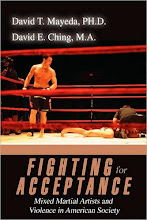
my book trying to illustrate positive dimensions to the sport. Nevertheless, MMA is a violent, male-dominated, collision sport, so like gridiron football, hockey, and basketball, dimensions of traditional masculinity are going to emerge.

To see the latest example of hegemonic masculinity promoted through MMA, we can look to the upcoming super fight between Ultimate Fighting Championship (UFC) Heavyweight Champ, Brock Lesner, and Interim Champ, Shane Carwin. Hegemonic masculinity refers to the multiple social qualities honored at a given moment in time that privilege men over all women (and girls) and other men. Since MMA is generally a competition between men, the ways that men emasculate one another is partiularly germane here.

Back in the late 1980s, heavyweight boxer Mike Tyson was labeled "The Baddest Man on the Planet." He was the smaller sized heavyweight who tore through bigger, slower oppents with an explosive fury. Outside of his minority status as an under-educated African American, Tyson exemplifed virtually every other key aspect of hegemonic masculinity; he was big, strong, violent, and wealthy. He carried multiple levels of power, which were perpetuated through his ongoing domination over women privately and other men publicly.

In today's world of combat sports, the "Baddest Men on the Planet" are said to be mixed martial arts' elite heavyweights (notably, both of whom are white). Check out the following promotional YouTube video, featuring Lesner and Carwin. Note the obvious visual and verbal references to physical strength and size, and at 4:17, pay attention to UFC President, Dana White: "At the end of the day, what really means something, is to be the baddest dude on the planet. I'm the Heavyweight Champion of the World."


UFC 116 Lesnar vs Carwin Promo (HD)


So while this is not an all encompasing example of hegemonic masculinity (for instance, education and technical prowess are not promoted), the promotional tactics used here certainly highlight what qualities are defined as masculine -- size, power, the ability to unleash physical violence -- and how much those qualities are valued in the excessively masculine domain of MMA.


Two weeks before the big July 3 competition. More to come...

Academics Blogs

Teaching Sociology: Over-population, Religion, and Sex Education

I find one of the most effective ways to illustrate how major institutions (government, religion, education, the family, work) influence individuals and the broader society is through discussion of over-population in various countries. The Philippines in particular stands as a perfect example.

Back in March 2009, Al Jazeera's "People and Power" program put together a great documentary titled, "
Critical Mass in the Philippines." The 12-minute YouTube video demonstrates how the Catholic church impacts the Philippine government, families, and schools in such a way that the already over-populated country has generally done nothing to address population growth, despite extensive poverty levels. See the video, below:


IRIN has a more recent story covering the country's evolving movement to curb over-population in the Philippines: "
Sex education plan sparks furious debate." From the IRIN story:


A controversy is raging in the Philippines over a sex education programme aimed at cutting the population growth rate, which is blamed for massive poverty in the Southeast Asian country of about 92 million.

Openly talking about sex remains taboo in many quarters of Philippine society but all that is changing as the government introduces a controversial sex education programme to public school pupils.

The influential Roman Catholic Church is demanding the plan be scrapped, but the cash-strapped government is struggling to contain an annual population growth rate of more than 2 percent.


It's interesting to note the different values being expressed by leaders of the sex education movement versus those being expressed by the Roman Catholic chuch.


“Our role here is to educate the young people on issues that directly affect them and empower them to make informed choices and decisions,” Valisno told reporters, explaining that the sex education modules would be integrated in various subjects, including science and health.

Topics will range from personal hygiene to reproductive health. Issues relating to pre-marital sex, teenage pregnancy, as well as HIV and AIDS, will also be discussed, she said.

And the church's point of view:


“These issues are not for children,” said Monsignor Pedro Quitorio, CBCP’s media director. “This is better left to the parents. This will just lead to promiscuity. Sex should be taught as a gift from God and not just the physical aspect of it.”


Lots of other related issues can also be discussed as they relate to over-population.
Kevin Bales, for instance, argues that over-population is among the most influential causes of contemporary slavery.

And finally, comparative research can be pulled into the discussion. At least in developed countries, Alexander McKay has conducted some of the most influential research on the topic. A very recent 2010 study speaks to the importance of sex education, teen pregnancies, and women's rise along the socio-economic ladder.
Quoting McKay:

In general, young women who are feeling optimistic about their futures tend to delay childbearing, he noted.

[...]

"As soon as we start to see the socio-economic circumstances of young women in Canada deteriorate, we can expect to see a parallel increase in the teen pregnancy rate," he said.

"In order to keep the teen pregnancy rate low, we have to ensure that teenage women in Canada are receiving high-quality sexual health education and access to sexual and reproductive health services. If those decline, we will also be seeing an increase in teen pregnancy rates going forward."

McKay cautioned that not all teen pregnancies are necessarily a bad thing.

"In some ethno-cultural communities having a child at the age of 18 or 19 can be an expected and normal thing," he said.

"But what we do find in the bigger picture is that high rates of teen pregnancy can be quite clearly linked to socio-economic disadvantage among young women in particular communities. So for example, where you see high rates of inner-city poverty in the United States, that's clearly linked to higher rates of teen pregnancy."


As sex education, hopefully quality sex education, begins to matriculate into developing countries, it will be interesting to see how effective it is in impacting teen pregnancies. In all likelihood, progress will be slow, as religious groups will probably slow these programs' growth. Still, small evaluation studies could be carried out, which could then pave the way for future public/educational policies at the national level.

Academics Blogs

Saturday, June 19, 2010

Enoying the World Cup? Doubt it if the slaves are.

I get that it's symbolically important for developing countries to host these massive sporting events. And it's important that privileged countries in the global north are not the only countries hosting the Olympic Games and World Cup. At the same time, when these international sporting events extend the most horrific of crimes, governments, major corporate entities (FIFA), and the profiting criminals must be held accountable.

Saw this January 2010 story from
Time Magazine analyzed with tons of other important information and linked over on GlobalSociology.com.

Despite more than a dozen international conventions banning slavery in the past 150 years, there are more slaves today than at any point in human history. Slaves are those forced to perform services for no pay beyond subsistence and for the profit of others who hold them through fraud and violence. While most are held in debt bondage in the poorest regions of South Asia, some are trafficked in the midst of thriving development. Such is the case here in Africa's wealthiest country, the host of this year's World Cup. While South Africa invests billions to prepare its infrastructure for the half-million visitors expected to attend, tens of thousands of children have become ensnared in sexual slavery, and those who profit from their abuse are also preparing for the tournament. During a three-week investigation into human-trafficking syndicates operating near two stadiums, I found a lucrative trade in child sex. The children, sold for as little as $45, can earn more than $600 per night for their captors.

Slavery in contemporary society is best analyzed through the prisim of critical criminology, which illustrates how those in power profit by crime and are protected by laws which govern society. The most vulnerable are used as pawns by criminal enterprisers, turned into victims (in this case slaves) and/or low-end workers that take the fall for the criminal elites. The criminal elites also collude with enforcement and other governmental agencies in order to maintain their free status. One of a few differences between slavery now and yester-year is that today, sex slavery so often leads to an early death sentence due to AIDS. More from the Time story:


Although its 1996 constitution expressly forbids slavery, South Africa has no stand-alone law against human trafficking in all its forms. Aid groups estimate that some 38,000 children are trapped in the sex trade there. More than 500 mostly small-scale trafficking syndicates — Nigerian, Chinese, Indian and Russian, among others — collude with South African partners, including recruiters and corrupt police officials, to enslave local victims. The country's estimated 1.4 million AIDS orphans are especially vulnerable. South Africa has more HIV cases than any other nation, and a child sold into its sex industry will often face an early grave.

[...]

At best, the South African government's response to child sex trafficking has been superficial or piecemeal; at worst, some officials have actually colluded with the traffickers. American and South African law-enforcement sources described how police at all levels have solicited underage prostitutes in Bloemfontein, Durban and other World Cup cities. South African officials claim that Parliament will pass a comprehensive law against human trafficking in early 2010. For now, enterprising police officers who take on human traffickers do so with few legal tools at their disposal. Convictions for trafficking-related offenses typically bring little or no jail time.

Organizations have made important campaigns to reduce these crimes against women and children (see
here and here). However, these efforts have a massive uphill battle against the much larger patriarchal machine that intertwines the legal system, law enforcement, and criminal enterprises.

Academics Blogs

Friday, June 18, 2010

"Outsourced": Using the Global Economy to Make Fun of Brown People

So NBC is coming out with a new sitcom called "Outsourced." The name itself reflects what's been happening across the world since transnational corporations (TNC) realized giving Americans decent wages and benefits didn't stand in line with greedy desires for outrageous profits. Hey, instead, take production and/or customer service to a low-income country, save money on worker fees, but maintain income in sales. Justify it by saying you're bringing development to the low-income countries, but don't pay the workers there adequate wages.

In countries like India and the Philippines, where English is fairly widely spoken, outsourcing of customer service call centers is big business for companies in the U.K. and U.S. (see Slumdog Millionaire?).
Kiran Mirchandi (2004) aruges that call centers in India offer a multitude of social experiences for employees, some of which include making fun of American callers. However, the reality is not always rosy:

You need at least three to four hours of sleep in the night. That’s what makes the big difference. …That is what is making it difficult. I’m losing my appetite, I’m losing my weight … suddenly we were told we would be having our [shift] from twelve [midnight] to eight. It was very difficult to adjust in the first few weeks. Then I got adjusted to that time. Then again we were told that you’re having your shifts from 7.30 till 4 a.m. And this shift, I find it very difficult to adjust. That is because I get home around 7 a.m., and it’s very difficult to sleep in the morning because people wake up, they go around here and there. (p. 364, 365).

Yet this is considered "privileged" work in a low-income country like India. Again, this notion of being a corporate benefactor to the Indian economy is mere justifcation by TNCs for making money and taking away jobs/benefits from American workers.

Of course in the realm of popular culture, these issues will not be addressed, or perhaps they will be glossed over in humorous bits. The "Outsourced" trailer:


Note also in the trailer how accents, names, attire, and popular culture (e.g., music) are intertwined to make fun of Indians. Will American audiences really interpret the cheezehead and other American artifacts in ways that make fun of American culture? Or are they used to further make fun of Indians and India as a whole?

So what we have here is popular culture making fun of the new globalization, of the ways that colonialism operates in the twenty-first century. I wouldn't be surprised if this show is a big hit.

Citation: Mirchandi, K. (2004). Practices of global capital: gaps, cracks and ironies in transnational call centres in India. Global Networks, 4 (4), 355-373.

Academics Blogs
Blog Directory

Friday, June 4, 2010

American Culpability in Israeli Occupied Territories

A few days ago I briefly suggested that the global community (okay, I mean the global north) held some complicity in allowing Israel to continue their oppression over the Palestinian occupied territories.

Mark LeVine (professor of history at U.C. Irvine) articulates this stance much more eloquently, and drives the point to another level in his piece, "Israel's 'friends' also to blame." LeVine argues that the United States' motivation in supporting Israel has nothing to do with supporting Israel or political ideology.

Rather, our support of Israel lies covertly in bolstering the private weapons manufacturing industry:


We have pretended to be its friend, but we are the friend in the way your drug dealer is your friend, sitting with you late at night listening to your problems while hooking you up with your next fix - only in strange twist, the American people rather than the Israelis are paying for the habit their government and corporate elites grow richer sustaining.

We are the ultimate facilitators of this insane and immoral arrangement, which is part of our larger addiction to war that now reaches $1 trillion per year.


LeVine goes on to tie the United States' ongoing relationship with Israel to the broader Middle East and connects our current militaristic efforts to American history:


And now at least 10 people are dead because of the shame, because of the inability of Israel's best friends to look it in the eye and say: "Stop this insanity. Treat Palestinians like humans before you destroy not only them, but you."

We cannot say that because we are guilty as well, and the US has proved singularly unable to come to grips with our own culpability in occupations from Iraq and Afghanistan to Gaza and, of course, our own original sin, which demanded millions of dead native Americans to ensure the creation of the very country that now supplies Israel with its weapons and tells it everything is going to be okay.

Some day you can let the Palestinians have casinos and they will thank you.

Highly recommended read.

Academics Blogs

Thursday, June 3, 2010

Sports Leadership among Males in Preventing Violence Against Women and HIV in South Africa

For those who wonder how male athletes can begin shifting gender norms in society, check out the campaign against gender-based violence and HIV involving a handful of male pro athletes from South Africa. Notably, levels of HIV and violence against women in South Africa are outrageously high (see HERE and HERE).

This report by IRIN News overviews the media campaign:

These sporting talents will be Sports Ambassadors for Brothers for Life, a national campaign encouraging men to take a stand against gender-based violence and HIV.

They will promote messages on television, radio and outdoor advertising about the risks of alcohol and unprotected sex in relation to HIV, and support a national HIV
counselling and testing drive launched in April by President Jacob Zuma.

Although fewer men go to be tested or seek HIV/AIDS treatment than women, they have not been the main focus of previous prevention campaigns. Now, the Sports Ambassadors will be calling on men to "yenza kahle" (do the right thing).

"When good men don't stand up to be counted, HIV and AIDS spreads," said South Africa's Deputy President, Kgalema Motlanthe. "We call upon men of all classes and races to join the fight against HIV and AIDS, occupying the front trenches in this war through their social conduct."

The campaign begins strategically just before the World Cup kicks off, which will undoubtedly provoke excessive drinking, sex, and violence.

So now the question is, with South Africa's extremely high rates of HIV and violence against women already existing, will these male-led prevention efforts continue after the 2010 World Cup ends? If they do continue, kudos. If the campaign abruptly ends with the World Cup's departure, then we will know it was created simply for the theater -- to improve South Africa's international image while it hosts a major sporting event.

To be continued...

More on World Cup and South Africa's Homeless

Another good, quick video illustrating how the World Cup impacts the underprivileged in South Africa.


Original story: 'Clearing up' for the World Cup